
Amazon Basics High Density Foam Roller Review: Simple, Firm, and Reliable for Everyday Recovery
Introduction
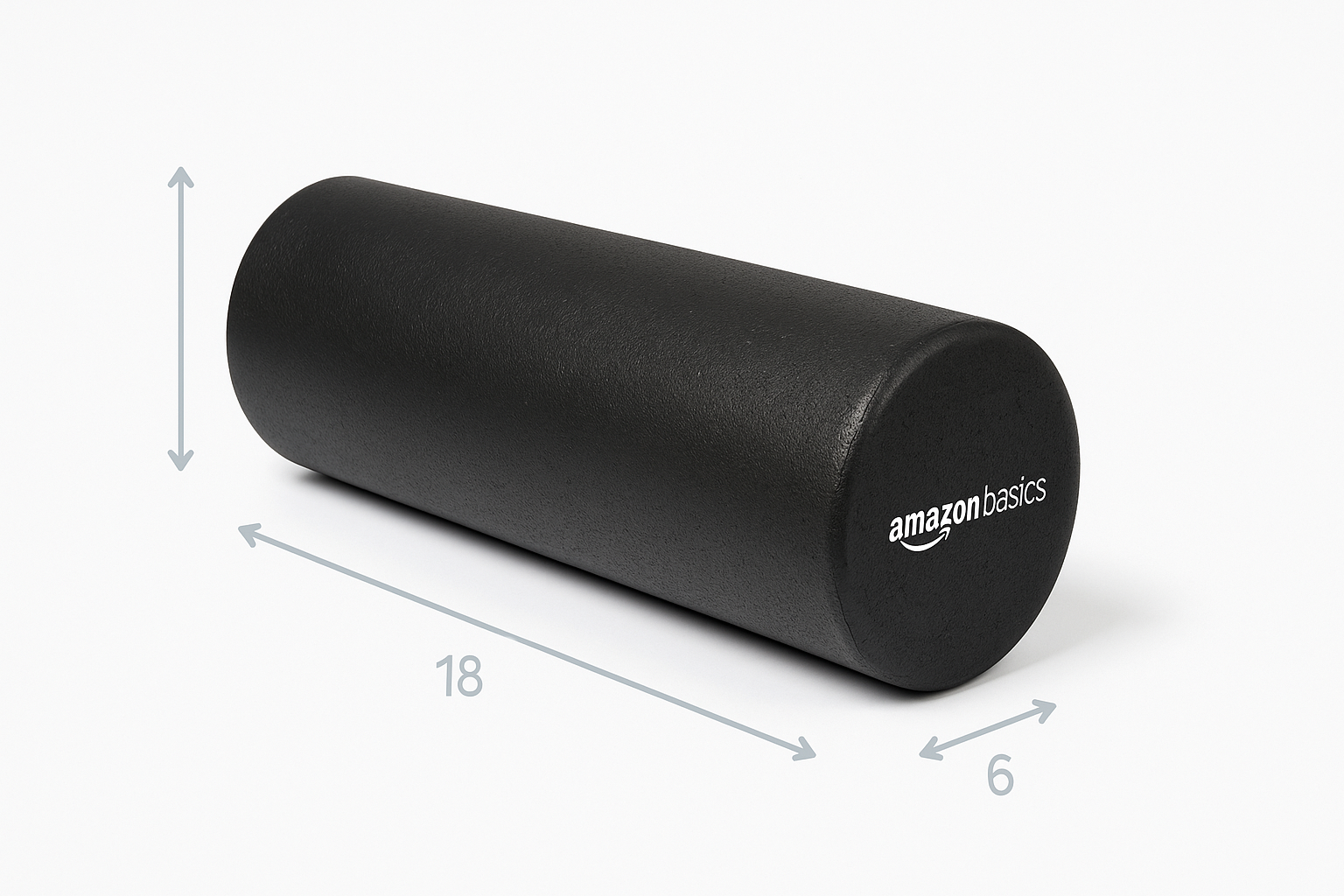
The Amazon Basics High Density Foam Roller is a straightforward recovery tool aimed at people who want firm pressure and dependable support without paying for premium branding or complex textures. Built from dense polypropylene foam, it’s designed to maintain its shape over time, provide consistent resistance, and stay light enough to move easily around the house or to the gym.
Offered at a budget-friendly price point of around $15.29, this model focuses on the essentials: a smooth cylindrical surface, high-density feel, and standard 18 x 6-inch dimensions that work well for most everyday recovery and exercise routines.
Typical Use Cases
1. Post-Workout Muscle Recovery
For many buyers, the primary job of this foam roller is general muscle recovery after strength training, running, cycling, or fitness classes. Used on large muscle groups—such as quads, hamstrings, calves, and upper back—it supports:
- Basic self-myofascial release
- Reducing post-workout tightness
- Helping restore range of motion over time
The roller’s high density means it delivers firm pressure, which can feel intense at first but is effective for people who prefer more robust compression than soft foam rollers provide.
2. Mobility and Flexibility Routines
The roller also doubles as a mobility tool, especially in warm-up and cool-down sessions. Common uses include:
- Thoracic spine mobility drills (rolling mid- to upper back)
- Passive chest-opening positions (lying along the roller lengthwise with arms out)
- Hip and glute release before or after lower-body work
Because it’s firm and uniform, it offers a stable base for controlled movement, which is important for users who are new to foam rolling and still learning technique.
3. Balance, Core, and Strength Exercises
Beyond recovery, the Amazon Basics High Density Foam Roller works well in exercise-focused routines, such as:
- Plank variations with hands or feet on the roller
- Bridges with feet on the roller to challenge hamstring and glute stability
- Single-leg balance work with the roller under one foot
The consistent cylinder shape and density keep it from collapsing under load, allowing you to treat it as both a prop and instability tool in bodyweight workouts.
4. Physical Therapy–Style Rehab Work
Many users pick up this roller on the recommendation of a trainer or therapist for home rehab exercises. Typical at-home PT applications include:
- Gentle upper-back mobilization for desk workers
- IT band area rolling (focusing more on surrounding muscles than directly on the band)
- Glute and hip external rotator release
Its smooth surface makes it suitable for gradual, consistent pressure rather than aggressive trigger-point work, which can be desirable for those easing into self-treatment.
Performance in Each Scenario
Recovery and Self-Myofascial Release
In post-workout recovery, the roller’s high density is its standout trait:
- Pressure: Delivers solid, uniform pressure across the contact area. Great for large muscle groups but may feel very intense for beginners.
- Surface feel: The lack of texture means the sensation is more diffuse than spiky or grid-style rollers, making it better for broad tissue compression than pinpoint trigger-point work.
- Durability under load: It retains its cylindrical shape without noticeable flattening, even for repeated daily use.
For users accustomed to soft foam, the first sessions can be uncomfortable, but many adapt quickly and come to appreciate the consistency.
Mobility and Flexibility Work
For mobility drills, especially along the thoracic spine (upper and mid back), the roller performs reliably:
- Support: The 18-inch length is long enough for most users to lie across it horizontally for back rolling without feeling unstable.
- Stability: Because it doesn’t flex much, it provides a predictable platform for slow, controlled movement.
- Ease of repositioning: The lightweight build makes it easy to shift under the body during sequences.
The main limitation is that it’s not long enough to fully support the entire body lengthwise (head to tailbone) for some Pilates or restorative yoga variations, though you can still use it lengthwise for upper-back and chest-opening work.
Balance and Strength Training
In core and balance exercises, the roller’s firmness and smooth surface offer:
- Consistent instability: It rolls evenly, so you know how it will respond when you put weight on it.
- Sufficient grip: While the exterior isn’t rubberized, the foam provides enough friction on most mats and hard floors to keep it from sliding excessively.
For movements like planks and bridges, it effectively increases the challenge without feeling flimsy or bending. Users who want to progress bodyweight training with minimal equipment will find it a practical, low-cost addition.
Rehab and Gentle Use
For rehab contexts, the roller is best suited to moderate-intensity work:
- Good for: Desk-related stiffness, general upper-back tightness, and gradual soft-tissue work around hips and legs.
- Less ideal for: Very sensitive users, people in acute pain, or those who have been told to start with a soft roller due to injury or medical conditions.
Because it is quite firm, some users recovering from injuries might need to build up tolerance or start with a softer option before moving to this density.
Strengths Across Scenarios
1. High Density and Shape Retention
The standout strength is right in the name: high density. Compared with inexpensive hollow or low-density rollers, this one:
- Resists flattening over time
- Provides consistent resistance session after session
- Supports users across a wide range of body weights
This density is especially appreciated by athletes and regular exercisers who find softer rollers too squishy.
2. Simple, Smooth Design
The cylindrical, smooth design benefits many scenarios:
- Easy to learn on for beginners—no complicated textures or patterns to worry about
- Comfortable for back rolling where aggressive ridges can feel too sharp
- Versatile for both exercise and recovery, rather than being specialized only for deep tissue work
3. Lightweight and Portable
Despite its firmness, the roller remains lightweight and easy to transport:
- Simple to carry to the gym or studio
- Easy to move around the house and store vertically or horizontally
This makes it a practical tool for people with limited space who need gear that can tuck away in a corner when not in use.
4. Value-Focused Pricing
With a list price hovering around $15.29 on Amazon, it’s positioned as a budget-conscious option that still delivers performance close to many mid-range rollers. For users who want to start foam rolling without investing in top-tier brands, the value proposition is strong.
Limitations Across Scenarios
1. Can Be Too Firm for Beginners or Sensitive Users
High density is a double-edged sword:
- New users often report that the first few sessions are painful or overly intense.
- People with very tight muscles, recent injuries, or certain conditions may find this roller too aggressive initially.
If you’re new to foam rolling or very pain-sensitive, you may need to start with shorter sessions, cushion some areas with a towel, or consider a softer roller first.
2. No Textured Surface for Deep Trigger-Point Work
The completely smooth surface is versatile but lacks specialized features:
- Less effective for users who want deep, targeted trigger-point release similar to massage balls or grid-pattern rollers.
- Advanced users might outgrow the broad-pressure feel and seek more aggressive tools for localized knots.
3. Fixed Size May Not Suit All Needs
This model’s 18 x 6-inch size is a common middle ground, but:
- Taller users or those wanting full-spine support lengthwise may prefer a 24- or 36-inch roller.
- People who mainly travel or foam roll in tight spaces might want a shorter, 12-inch option.
If you know you need travel-friendliness or full-length support specifically, it’s worth confirming which length variant you’re buying, as Amazon Basics also offers other sizes under similar listings.
4. Basic Aesthetics and Features
As a budget-focused product, the roller:
- Lacks premium flourishes like multi-density zones, ergonomic contours, or extra-grippy outer shells
- Comes in a straightforward, utilitarian look (often solid black), which may not matter for performance but is less appealing for users who care about aesthetics or brand cachet
Verdict
The Amazon Basics High Density Foam Roller delivers exactly what many users need from a first or primary foam roller: firm, reliable pressure; durable construction; and simple, versatile design at a wallet-friendly price of around $15.29.
It is best suited for:
- Active individuals seeking an affordable, dependable roller for regular post-workout recovery
- Home exercisers who want a dual-purpose tool for mobility work and core/balance training
- Users ready for a firm feel who don’t require aggressive textures or advanced design features
It may not be ideal if you’re very pain-sensitive, recovering from significant injury, or looking specifically for deep trigger-point tools or a premium, feature-rich roller.
Overall, if you want a no-nonsense, high-density foam roller that does the basics very well and fits comfortably into most home-gym budgets, the Amazon Basics High Density Foam Roller is a strong, practical choice.