
Elikliv EDM4 4.3-Inch LCD Digital Coin Microscope Review: Affordable Detail for Hobbyists and Tinkerers
Introduction
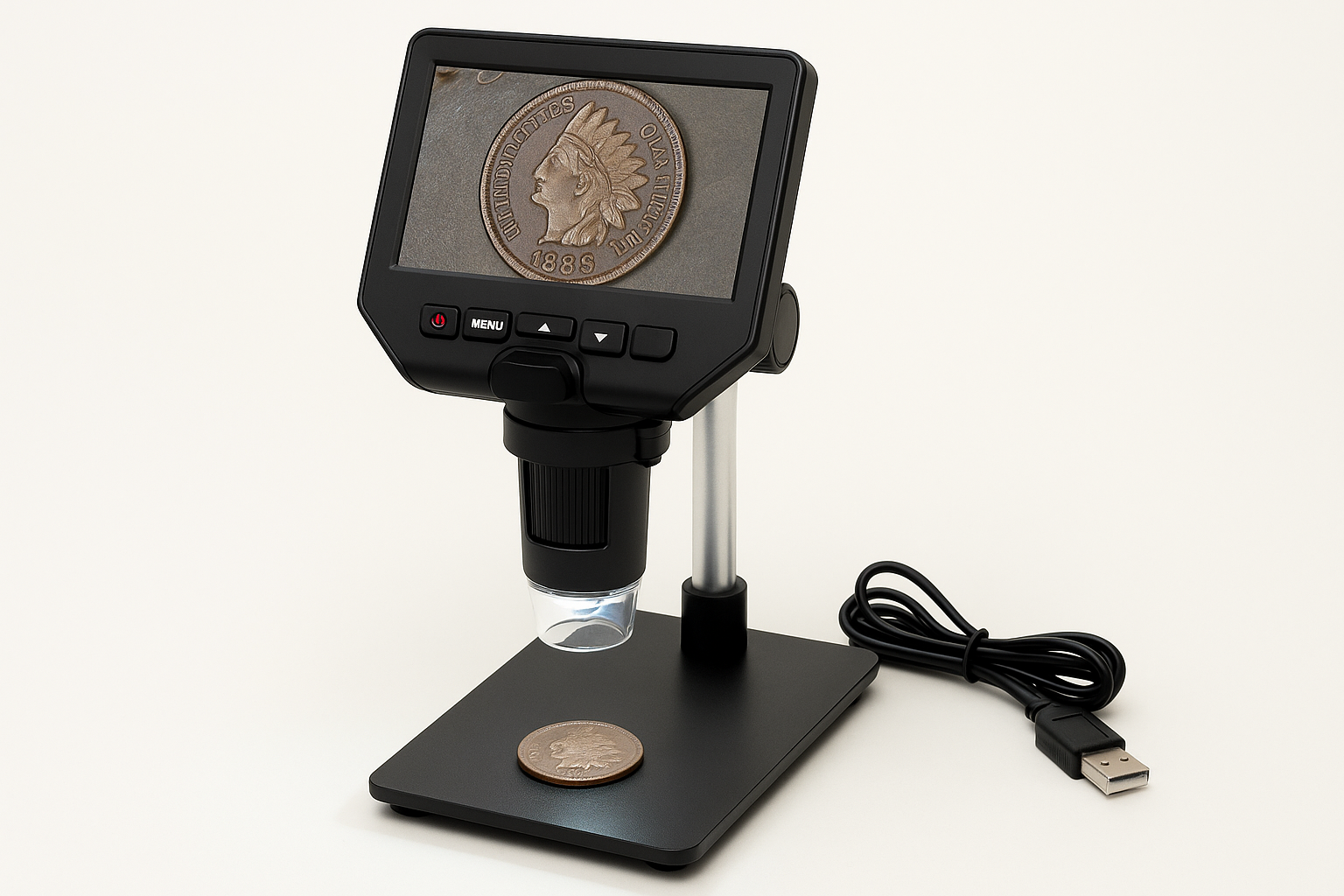
The Elikliv EDM4 4.3-Inch LCD Digital Coin Microscope is designed as an all-in-one inspection tool for coins, stamps, circuit boards, and other small objects. Instead of relying solely on a computer, it integrates a 4.3-inch color LCD screen, LED illumination, and a digital camera sensor into a compact unit. With a claimed magnification up to 1000x and support for photo and video capture to a microSD card (not included), it targets hobbyists who want more detail than a handheld loupe without the complexity or cost of a lab-grade microscope.
Positioned in the budget digital microscope category at around $33.24 on Amazon, the EDM4 emphasizes ease of use, portability, and sufficient clarity for inspection rather than scientific measurement.
Setup / Getting Started
What’s in the box
Typical packages for the Elikliv EDM4 include:
- Elikliv EDM4 digital microscope unit with 4.3" LCD
- Metal stand and vertical pole
- Adjustable holder for the microscope body
- Flat base plate (often metal or plastic depending on bundle)
- USB cable (for power and PC connection)
- User manual
A microSD card is not usually included, so you’ll need to provide your own (up to 32 GB is commonly supported) if you want to save photos and videos directly from the scope.
Assembly
Assembly is straightforward and can be done in a few minutes:
- Attach the pole to the base using the supplied screw.
- Mount the adjustable holder onto the pole and tighten it at a comfortable working height.
- Insert the microscope body into the holder and secure it with the tightening knob.
- Connect power using the supplied USB cable, either to a USB power adapter, power bank, or PC.
Adjust the stand so the lens is roughly over the center of your working area. For coin collectors, this typically means placing a 2x2 flip or raw coin directly under the lens and adjusting the height until the coin fills a good portion of the screen.
Initial configuration
Once powered on, the EDM4 boots to a live-view image on the LCD. Basic configuration steps include:
- Language and time/date (if available in your firmware version) to correctly timestamp saved images.
- Brightness of the 8 LEDs using the side wheel or on-screen controls, depending on revision.
- Focus and working distance by moving the microscope up or down the stand and turning the focus wheel until the image is sharp.
If you plan to connect the microscope to a PC:
- For Windows, you can typically use built-in camera apps or basic capture software after the EDM4 is recognized as a standard USB camera.
- For MacBook, it usually appears as a USB webcam that can be accessed via apps like Photo Booth or third-party capture tools.
Daily Usage
Ergonomics and handling
The 4.3-inch LCD offers a comfortable viewing area without needing to hunch over a laptop screen. Compared with using a loupe, the EDM4 allows you to keep a more relaxed posture, especially during longer sessions inspecting rolls of coins or checking multiple PCBs.
The stand provides basic height adjustment but is relatively light. It’s adequate for tabletop use, though you may notice minor wobble if you frequently bump the table. For delicate soldering work under the lens, some users opt to add weight to the base or clamp it to the workbench.
The controls are generally simple:
- Buttons for capturing photos and videos
- Navigation keys for menu settings
- A focus wheel around the lens
- A brightness control for the LED ring
Once you understand the focus behavior (the highest usable magnification is reached at a relatively close working distance), daily operation becomes intuitive: place the object, adjust height and focus, tweak lighting, and capture images as needed.
Use cases
Typical day-to-day uses for the Elikliv EDM4 include:
- Coin and currency inspection – Checking mint marks, die cracks, repunched dates, and surface conditions.
- Stamp and paper collectibles – Inspecting perforations, printing details, and paper texture.
- Electronics and soldering – Looking at solder joints, traces, and small components, especially for hobby electronics.
- Jewelry and gemstones – Inspecting settings, hallmarks, and surface imperfections.
- STEM education for kids – Viewing fibers, insects, and small household objects to spark curiosity.
For quick checks and casual exploration, the built-in screen is often enough. When you want to share or analyze details more carefully, connecting to a PC or saving images to a card is helpful.
Performance & Reliability
Magnification and image quality
The EDM4 is advertised with a 50–1000x magnification range. As with most digital microscopes, these numbers are a mix of optical and digital magnification, and the exact effective magnification depends on:
- The distance between the lens and the subject
- The size of the LCD or external monitor you use
In practice:
- At lower magnifications, you can see an entire coin or a large portion of a circuit board.
- At higher magnifications, you focus on finer details such as small date digits, micro-text on coins, or individual solder joints.
Image quality is generally good for the price tier:
- The LCD is bright enough for indoor use and offers acceptable color reproduction.
- The sensor can output up to 1080p for video, with photo resolutions in the VGA–2 MP range depending on settings.
- Fine details on metal surfaces and PCBs are usually clear, though not on par with high-end optical or stereo microscopes.
Because this is an inexpensive digital scope, you should expect some limitations:
- Dynamic range is modest; bright reflections from polished metal can blow out highlights.
- At very high magnification, depth of field is shallow, requiring careful focus.
Lighting
The built-in ring of 8 adjustable LEDs is crucial for the microscope’s usability. Being able to adjust brightness directly helps mitigate glare and shadows when viewing reflective objects like coins, jewelry, and solder pads.
For most indoor environments:
- Mid-level brightness works well.
- Higher settings can cause reflections on shiny surfaces; angling the coin or slightly increasing the working distance helps.
PC connectivity
The EDM4 supports PC view via USB.
- On Windows, it typically appears as a standard USB camera. You can use common capture applications to view and record at resolutions like 640×480 or 1280×720.
- On MacBook, compatibility is usually similar: the device behaves like a webcam, and you can use native or third‑party apps to access the live feed.
This is useful when:
- You want a larger viewing area than the 4.3" screen.
- You need to record sessions or annotate images directly in software.
Reliability and build
The EDM4 is mostly plastic with a simple metal stand. For a lightweight hobby tool, this is acceptable, but it’s not built like industrial inspection microscopes.
Long-term ownership experiences (from various users) typically report:
- Stable operation during extended sessions when powered from USB.
- Occasional reports of battery-related issues or units that don’t hold a charge well, which is less of a concern if you plan to keep it plugged in.
- Controls and buttons that remain functional with normal use, though they feel more “budget” than premium.
As with any budget electronics, quality control can vary slightly between units, but overall reliability aligns with expectations in this price bracket.
What Works Well
-
Integrated 4.3" LCD screen
No need for a PC for basic inspection; you can place an object and start viewing almost immediately. -
Good value for hobby use
At about $33.24, the EDM4 delivers a usable blend of magnification, lighting, and recording for coins and electronics without a large investment. -
Adjustable 8-LED illumination
Built-in, dimmable ring lighting makes it versatile under different ambient lighting conditions and with varied surface finishes. -
Photo and video capture support
With a microSD card installed, you can capture images and clips directly from the scope, helpful for documenting coin varieties, stamp flaws, or electronics work. -
PC connectivity (Windows and MacBook)
Being recognized as a standard USB camera means you can easily use popular software for live viewing, recording, or streaming. -
Broad use cases
Suitable for coins, stamps, jewelry, PCBs, small mechanical parts, and general curiosity-driven exploration—especially for students and hobbyists.
What Could Be Improved
-
Stand stability and precision
The included stand is functional but can feel light and a bit wobbly if the table is bumped. Finer height adjustment and a heavier base would improve focusing accuracy, especially at high magnification. -
Working distance at maximum magnification
As with many compact digital microscopes, the highest magnification requires placing the lens quite close to the object. That can make hands-on tasks under the lens, like very fine soldering, more challenging. -
Battery performance and reliance on USB power
Some users report that internal batteries on similar models don’t hold up well over time. Treating it as a mostly tethered device (to a USB power source) often yields the most reliable experience. -
Optical clarity vs. higher-end scopes
For serious numismatists or professional electronics work, the image quality and depth perception (it’s a single-camera digital system) may not match that of stereo microscopes or more advanced setups. -
Limited on-device interface
Menu systems and settings are basic. While simple to learn, they don’t offer extensive fine-tuning for exposure, color balance, or advanced capture settings.
Overall Impression
The Elikliv EDM4 4.3-Inch LCD Digital Coin Microscope offers a compelling entry point into digital microscopy for hobbyists, coin collectors, and electronics tinkerers. It combines a practical feature set—built-in screen, adjustable LEDs, photo/video capture, and PC connectivity—at an accessible price point like $33.24.
It’s best suited for:
- Coin and stamp collectors who want clear, close-up views of details and an easy way to document finds.
- Electronics hobbyists inspecting solder joints and small components, especially when ultra-fine work is not required.
- Students and curious learners exploring small objects at home or in informal classroom environments.
Those needing professional-grade optics, stereo depth perception, or highly stable mechanical stands may outgrow this model and look to more advanced microscopes. However, for its target audience and price tier, the Elikliv EDM4 delivers solid everyday performance and convenience. If you’re looking for a budget-friendly digital microscope that goes beyond a simple loupe while remaining portable and easy to use, this model is a strong candidate to consider.