
Gskyer 70mm AZ70400 Telescope Review: A Travel‑Friendly Starter Scope for Kids and Beginners
Gskyer 70mm AZ70400 Telescope Review: A Travel‑Friendly Starter Scope for Kids and Beginners
Introduction
The Gskyer Telescope, 70mm Aperture 400mm AZ Mount Astronomical Refracting Telescope for Kids Beginners is a compact refractor designed as an all‑in‑one starter kit. With a 70mm objective lens, 400mm focal length (f/5.7), and a simple altazimuth (AZ) mount, it targets families, students, and first‑time observers who want an easy introduction to the night sky without dealing with complex equatorial mounts or heavy equipment. (gskyer.com)
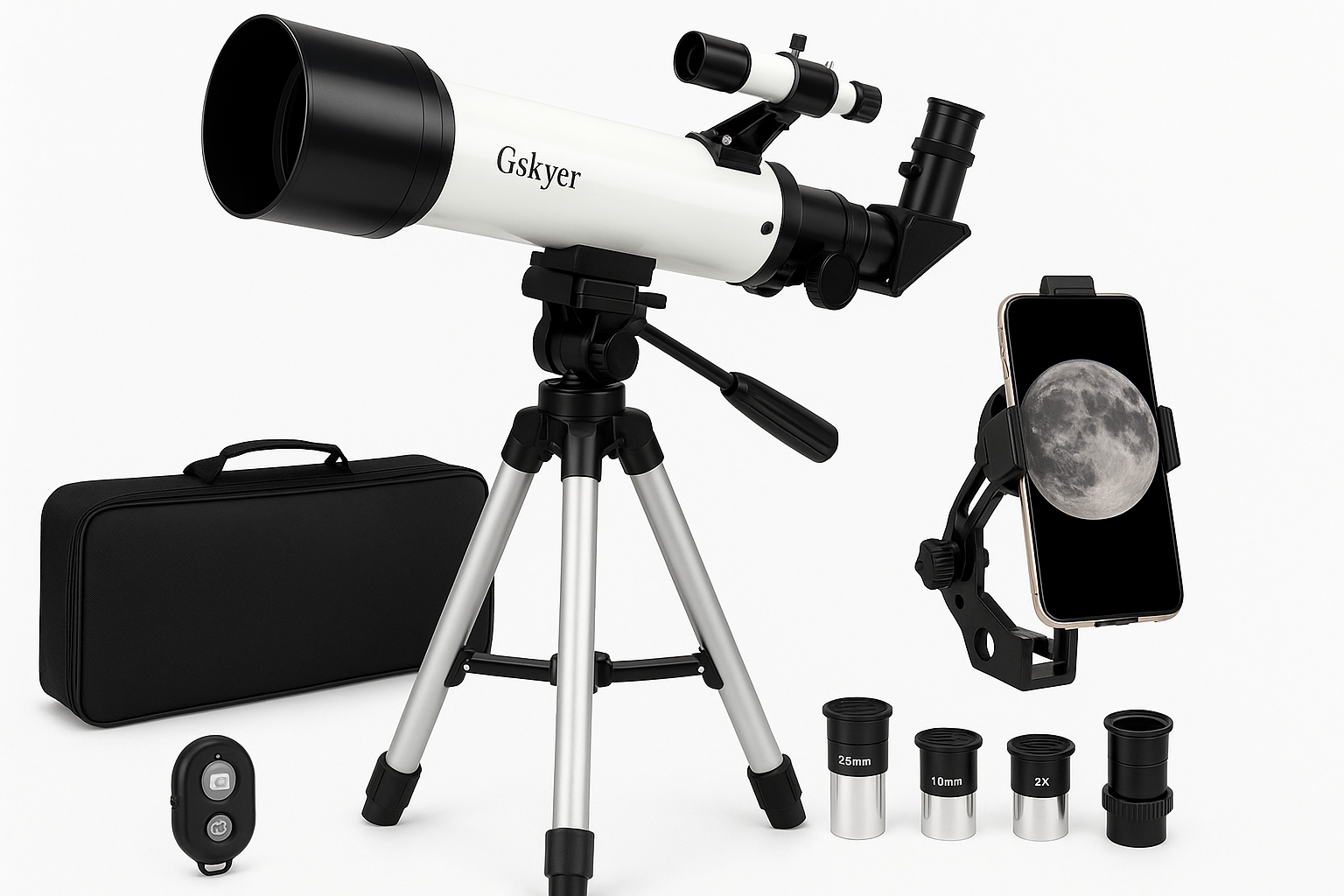
This model (often referred to as the AZ70400) ships with a carry bag, adjustable aluminum tripod, smartphone adapter, and wireless Bluetooth remote, making it particularly appealing for travel, camping trips, and educational use. (whimsy-workss.com)
Key Points
- Optical design: 70mm achromatic refractor with 400mm focal length (f/5.7) for wide‑field views and easy target acquisition. (gskyer.com)
- Mount: Manual altazimuth mount with pan‑handle control; intuitive for beginners but not designed for high‑magnification tracking. (manuals.plus)
- Included eyepieces & Barlow: 10mm and 25mm eyepieces plus a 3× Barlow lens, covering low to medium‑high practical magnifications suitable for the Moon and bright planets. (gskyer.com)
- Accessories: 5×24 finder scope, 90° diagonal, smartphone adapter, wireless camera remote, accessory tray, and padded carry bag included in the box. (whimsy-workss.com)
- Target user: Kids, teens, and adults who want a first telescope for casual stargazing and simple smartphone photography, not advanced astrophotography.
- Value positioning: Designed as a budget‑friendly beginner scope that delivers good introductory performance around the $96.98 mark (pricing can fluctuate, so always check the latest listing).
Experience
Setup and First Impressions
Out of the box, the Gskyer 70mm AZ70400 is clearly aimed at simplicity. The aluminum tripod, AZ mount, and optical tube arrive mostly pre‑assembled, and no tools are required for final setup. Many users can go from unboxing to their first look at the Moon in roughly 10–15 minutes after a quick read of the manual. (gskyer.com)
The tripod is lightweight and folds down compactly, which is ideal for travel and storage. Height adjustment covers a typical range for kids and seated adults, and the accessory tray helps keep eyepieces organized. While convenient, the low weight also means the system is more prone to vibrations when focusing at higher magnifications, a common trade‑off in entry‑level kits. (gskyer.com)
The optical tube feels reasonably solid for its price class, with fully coated or multi‑coated glass optics designed to boost light transmission and reduce reflections. Expect minor plastic components in the focuser and finder mount, which is standard at this level.
Optical Performance
With a 70mm aperture, this telescope gathers enough light for bright targets:
- Moon: The 25mm eyepiece provides wide, crisp views of the entire lunar disk, while the 10mm eyepiece reveals craters, rilles, and mare boundaries with satisfying detail on steady nights.
- Planets: Jupiter’s main cloud bands and its four Galilean moons are within reach, as are Saturn’s ring system and larger moons under good seeing. Mars shows as a small disk, with occasional polar cap hints at opposition.
- Star clusters and bright nebulae: Open clusters (e.g., the Pleiades) look attractive, and bright nebulae such as Orion’s M42 appear as faint, diffuse glows—enough to spark interest, though not the richly detailed views of larger, more expensive scopes.
The included 3× Barlow substantially boosts magnification but also magnifies any atmospheric turbulence and mechanical vibration, so it’s best used sparingly and under good conditions. As with most fast (f/5.7) achromatic refractors, you may notice chromatic aberration—a faint purple or blue fringe—around very bright objects like the Moon’s limb or Venus. This is normal at this price and doesn’t prevent enjoyable viewing.
Mount and Focusing
The altazimuth mount uses a simple pan‑handle for up‑down and left‑right motion, which is intuitive for kids and new users. Sweeping the sky feels natural, but fine adjustments at high magnification need a gentle touch. A heavier tripod or added weight can help dampen vibrations.
The rack‑and‑pinion focuser accepts 1.25‑inch eyepieces, allowing future upgrades. Focusing is straightforward, though you may see some image shake while turning the knobs. Once you stop adjusting focus, the image typically settles within a second or two.
Smartphone Adapter and Wireless Remote
One of the standout aspects of this kit is its focus on phone‑based astrophotography. The included smartphone adapter clamps your device over the eyepiece so you can view and capture images on‑screen. Combined with the wireless Bluetooth remote, you can trigger photos without touching the phone, significantly reducing blur. (whimsy-workss.com)
You should temper expectations: phone images will be best on the Moon and bright planets, not on faint galaxies or nebulae. Still, for sharing quick snapshots on social media or creating a child’s first astronomy scrapbook, it adds a lot of fun.
Portability and Use Cases
Weighing only a few kilograms with a compact tube length of about 400mm, the Gskyer 70mm is easy to carry to the backyard, a local park, or a dark‑sky site. The padded carry bag fits the tube, tripod, and accessories, making it practical for car trips and camping.
Use cases where this scope works particularly well include:
- Family learning nights: A parent guiding kids through constellations and the Moon.
- STEM education: School astronomy clubs or science classes introducing basic observing.
- Casual travel astronomy: Bringing a small scope on vacation to enjoy dark skies without hauling heavy gear.
Pros
- Beginner‑friendly design: Simple altazimuth mount is easy to understand, even for young observers.
- All‑in‑one accessory bundle: Eyepieces, 3× Barlow, diagonal, finder, phone adapter, remote, and carry bag included—no immediate add‑ons required. (whimsy-workss.com)
- Good starter aperture: 70mm objective balances portability with enough light for the Moon, planets, and bright deep‑sky objects.
- Fast setup: Tool‑free, quick assembly encourages frequent use and spontaneous sessions.
- Portable and lightweight: Ideal for small homes, travel, and camping.
- 1.25‑inch eyepiece format: Offers upgrade paths to better eyepieces and filters later.
- Budget‑oriented pricing: Positioned as an affordable first telescope around $96.98, depending on current promotions and availability.
Cons
- Tripod vibrations: Lightweight tripod can shake at higher magnifications; focusing and wind may cause short image wobble.
- Entry‑level optics: Some chromatic aberration and limited contrast compared with larger or more advanced scopes.
- Basic finder scope: The 5×24 finder is usable but not especially bright or wide; alignment takes patience. (gskyer.com)
- Not for serious astrophotography: Lacks motorized tracking and the stability needed for long‑exposure imaging.
- Learning curve for phone photography: Positioning the smartphone adapter can be fiddly at first, especially for younger users.
Verdict
The Gskyer 70mm Aperture 400mm AZ Mount Astronomical Refracting Telescope is a thoughtfully packaged beginner’s telescope that lowers the barrier to entry for kids, families, and casual observers. Its combination of a 70mm refractor, intuitive altazimuth mount, extensive accessory kit, and smartphone‑friendly features makes it well‑suited for first explorations of the Moon, planets, and bright deep‑sky objects.
It does carry the usual limitations of budget starter scopes—most notably a light tripod, some optical compromises, and the absence of advanced features. Enthusiasts seeking long‑term, high‑precision observing or imaging will eventually want to upgrade to a larger, more robust system.
However, as a first step into astronomy, especially at a price point around $96.98, the Gskyer 70mm AZ70400 offers a compelling balance of portability, ease of use, and educational value. If your primary goal is to spark curiosity about the night sky, capture a few memorable smartphone shots, and learn the basics of telescopic observing, this kit is a strong contender.