
Scotts Turf Builder Starter Fertilizer for New Grass (15 lb, 5,000 sq. ft.) Review
Product Context
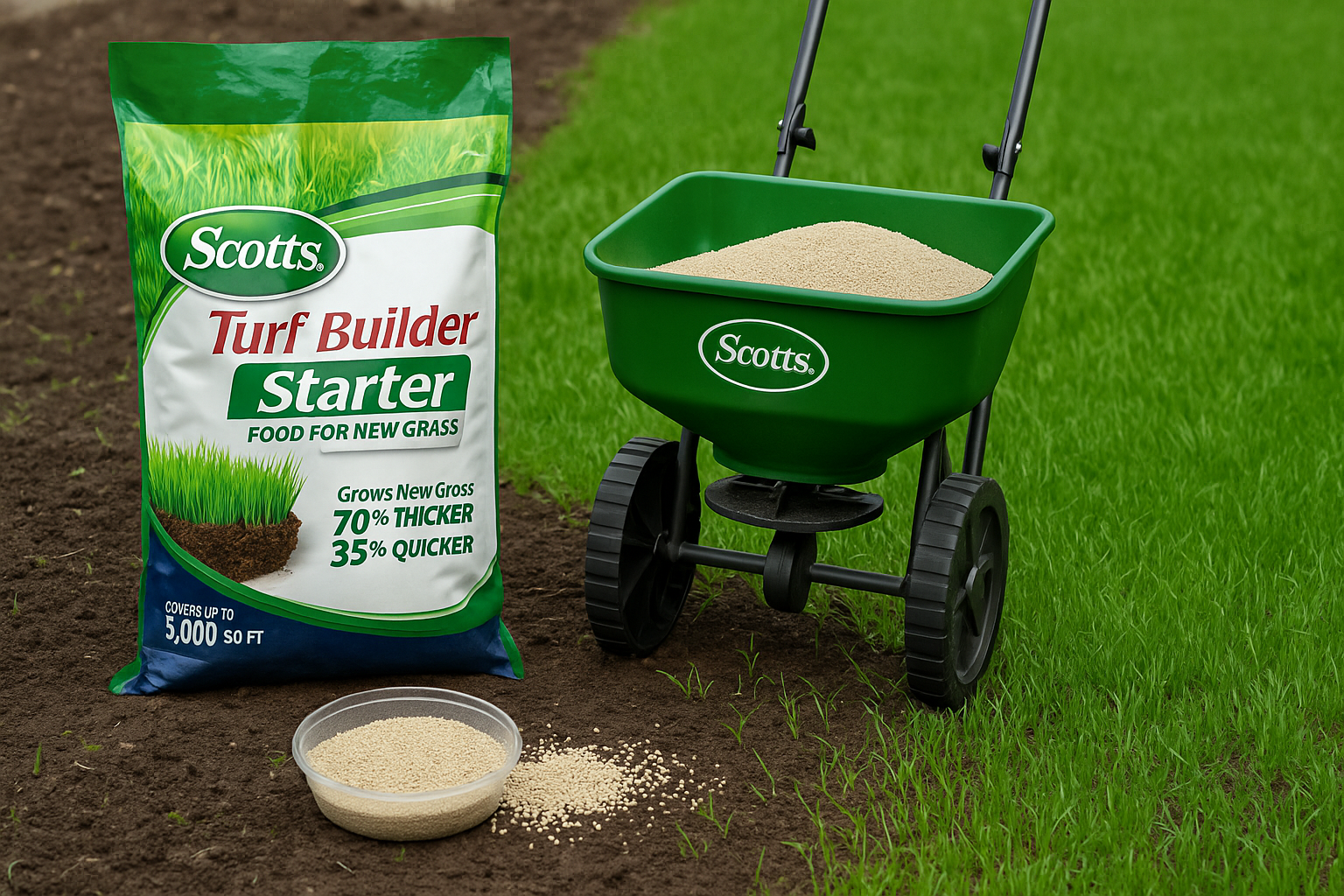
Scotts Turf Builder Starter Fertilizer for New Grass (15 lbs, covers up to 5,000 sq. ft.) is a phosphorus-rich starter fertilizer formulated to support early root and shoot development in new lawns. It’s intended for use when:
- Starting a brand-new lawn from seed
- Reseeding or overseeding an existing thin lawn
- Installing sod, sprigs, or grass plugs
The product uses a 24-25-4 NPK analysis, meaning it delivers relatively high nitrogen and phosphorus with modest potassium, a combination aimed at getting new turf established faster and thicker than if it were left unfed.(hartvillehardware.com)
Unlike many standard lawn fertilizers that contain little or no phosphorus, this starter formulation specifically targets the nutrient profile most important to new root growth, which is especially useful in soils that are not already high in phosphorus.
Feature Breakdown
Formulation and Nutrient Profile
- NPK ratio 24-25-4: High nitrogen (for top growth and early color), high phosphorus (for root development), and modest potassium (general stress tolerance).(hartvillehardware.com)
- Granular, dry fertilizer: Easy to apply with standard broadcast or drop spreaders.
- Coverage: One 15 lb bag is rated to cover up to 5,000 sq. ft. at the recommended application rate, which aligns well with many suburban lawn sizes.(hartvillehardware.com)
Application Flexibility
Scotts positions this as a flexible starter product that can be used:
- Immediately before or after seeding
- When laying sod or sprigs
- For overseeding thin areas
It’s labeled as safe for use on any grass type, making it broadly applicable whether you’re growing cool-season grasses (like fescue, bluegrass, rye) or warm-season grasses (like Bermuda or Zoysia), provided the timing matches that grass’s optimal planting window.(lowes.com)
Claimed Performance Benefits
Scotts marketing claims that this Starter Fertilizer:
- Grows new grass up to 70% thicker and 35% quicker than an unfed lawn, on average.(hartvillehardware.com)
- Improves seeding results and overall establishment
While percentages come from Scotts’ internal or controlled tests, they’re directionally consistent with what you’d expect from a high-phosphorus starter applied correctly.
Performance Insights
Establishment Speed and Density
In typical use, what you can expect from a properly timed and applied starter fertilizer like this is:
- Faster initial greening once seedlings emerge, due to the substantial nitrogen component.
- More vigorous root development, which is especially important for sod to knit into the soil and for seed to tolerate early stress.
- Thicker fill-in of bare or thin areas compared with using seed alone, assuming adequate watering and decent soil preparation.
The high phosphorus content is particularly helpful when soil tests show low or moderate phosphorus. In high-phosphorus soils, the performance difference versus a balanced or low-P fertilizer may be less dramatic, and some regions restrict phosphorus applications for that reason (see Trade-offs below).
Consistency and Coverage
The granule size is fairly uniform, which helps promote even coverage when used with a compatible spreader. Scotts provides recommended spreader settings for its branded spreaders; for example:
- Broadcast/rotary spreaders: A mid-range setting (often around the 3–3.5 range on common Scotts models) is typically recommended.(lowes.com)
- Drop spreaders: A higher numeric setting is used to achieve the same application rate.
As with any granular product, making two perpendicular passes at a slightly reduced setting often improves uniformity and reduces striping.
Longevity
Under normal watering and growth conditions, you can expect several weeks of feeding from a single application—long enough to carry new grass through its most vulnerable early phase. Many homeowners will transition to a regular lawn fertilizer program later in the season once the turf is fully established.
Usability
Application Steps
A typical workflow with Scotts Turf Builder Starter Fertilizer for New Grass looks like this:
-
Prepare the soil
- Rake to remove debris and loosen the top layer (usually the top 1–2 inches).
- Correct major grading and compaction issues before seeding or laying sod.
-
Apply fertilizer
- Use a broadcast or drop spreader, following the bag’s coverage guidance (one 15 lb bag for up to 5,000 sq. ft.).(hartvillehardware.com)
- For more even coverage, overlap wheel tracks slightly and consider two passes.
-
Seed or lay sod
- Spread seed at the recommended rate or install sod/sprigs/plugs.
-
Water thoroughly
- Water immediately after application and planting, then keep the soil consistently moist—but not saturated—until the grass reaches about 2 inches tall.(lowes.com)
Safety and Re-Entry
Scotts indicates there are no strict re-entry restrictions beyond basic common sense: it’s best to water the product in and allow the lawn surface to dry before heavy use by people or pets.(scottsmiraclegro.com)
As with any fertilizer, you should avoid direct contact with skin and eyes, wash hands after use, and store the product away from children and animals.
Storage and Handling
- Store the bag in a dry area to prevent clumping.
- Seal partially used bags to preserve product quality for future applications.
- Follow local guidance for disposal of partially used product; never dump excess into storm drains or waterways.(scottsmiraclegro.com)
Cost and Value
This starter fertilizer typically sits in the mid-range among branded lawn fertilizers. On retailer listings, the 15 lb, 5,000 sq. ft. bag often appears around $29.98, which is competitive given its coverage and specialized formulation.
With that coverage, the cost per 1,000 sq. ft. is reasonable for a single, critical establishment-phase application—especially if you’re protecting a larger investment in high-quality seed or fresh sod.
Trade-offs
Pros
- Purpose-built for new lawns: High phosphorus and balanced nutrients specifically tuned for establishment.
- Broad grass-type compatibility: Labeled safe for any grass type, convenient if you’re not deeply versed in turf agronomy.(lowes.com)
- Good coverage per bag: Up to 5,000 sq. ft. from a 15 lb bag suits many average-size home lawns.(hartvillehardware.com)
- Improved early performance: Claims of thicker, faster growth are in line with how starter fertilizers generally perform when applied correctly and combined with good watering practices.(hartvillehardware.com)
Cons and Limitations
- Phosphorus regulations: Some states and municipalities restrict or prohibit phosphorus-containing lawn fertilizers unless a soil test indicates deficiency or you are establishing a new lawn. Buyers should check local rules before use.
- Risk of over-application: Applying too heavily can lead to nutrient runoff and potentially stress new turf. Carefully following coverage guidelines is important.
- Not an all-season solution: This is a starter product, not a year-round fertilizer. Once the lawn is established, you’ll still need a regular maintenance program tailored to your grass type and climate.
- Granular limitations: Like all granular products, performance relies on good soil contact and consistent watering. Poor watering habits or very compacted soil can blunt its benefits.
Conclusion
Scotts Turf Builder Starter Fertilizer for New Grass (15 lbs, 5,000 sq. ft.) is a well-formulated, widely available starter fertilizer that fits the needs of most homeowners establishing a new lawn from seed or sod. Its 24-25-4 nutrient profile, broad grass-type compatibility, and generous coverage make it a strong, convenient choice for accelerating early lawn establishment when paired with proper soil prep and irrigation.
If you’re investing in quality seed or sod and want to improve your odds of fast, dense coverage, this product offers good value at around $29.98 for a bag that can treat many typical residential yards in a single pass. Just be sure to respect local phosphorus regulations, apply with a properly calibrated spreader, and maintain consistent watering to get the best results.