
SkaterTrainers Review: A Simple Way to Learn Skateboard Tricks Faster and Safer
SkaterTrainers Review: Learn Skateboard Tricks Faster Without the Scary Slams
Introduction
Learning your first skateboard tricks is usually equal parts excitement and frustration. The board shoots out, you chase it down the driveway, and a couple of hard slams later you start wondering if skating is really for you. SkaterTrainers are designed specifically to tackle that moment.
This small set of rubber-like sleeves stretches over your skateboard wheels to stop them from rolling. By stabilizing the board, they let you focus on timing, foot placement, and confidence when learning basics like ollies, shove-its, and kickflips. Marketed toward all ages and experience levels, the SkaterTrainers- Skateboard Tricks Fast No Experience Needed- Fun, Safe, and Easy- Ollies, Kickflips and More promise to turn your regular setup into a training board you can use virtually anywhere.
They’re currently available on Amazon for around $28.99, which puts them in impulse-buy territory compared to a new deck or set of trucks. But do they actually make it easier to learn tricks, and are there any trade-offs you should know about before you add them to your cart?
Key Points
- Purpose-built for learning tricks: SkaterTrainers are designed to prevent your board from rolling so you can learn the movements of tricks in place.
- Beginner- and parent-friendly: Marketed for kids, teens, and adults with no prior experience; ideal as a first accessory with a new skateboard.
- Simple installation: Stretch-fit design that slips over the wheels in seconds and comes off just as easily—no tools required.
- Wide compatibility: Fits most standard trick skateboard wheels and many cruiser-style setups.
- Confidence booster: Reduces the fear of the board shooting out, encouraging more attempts and more consistent practice.
- Transition still required: You’ll still need to adapt the trick for rolling practice; SkaterTrainers are a stepping stone, not a replacement for real-world skating.
Experience
Design and Build
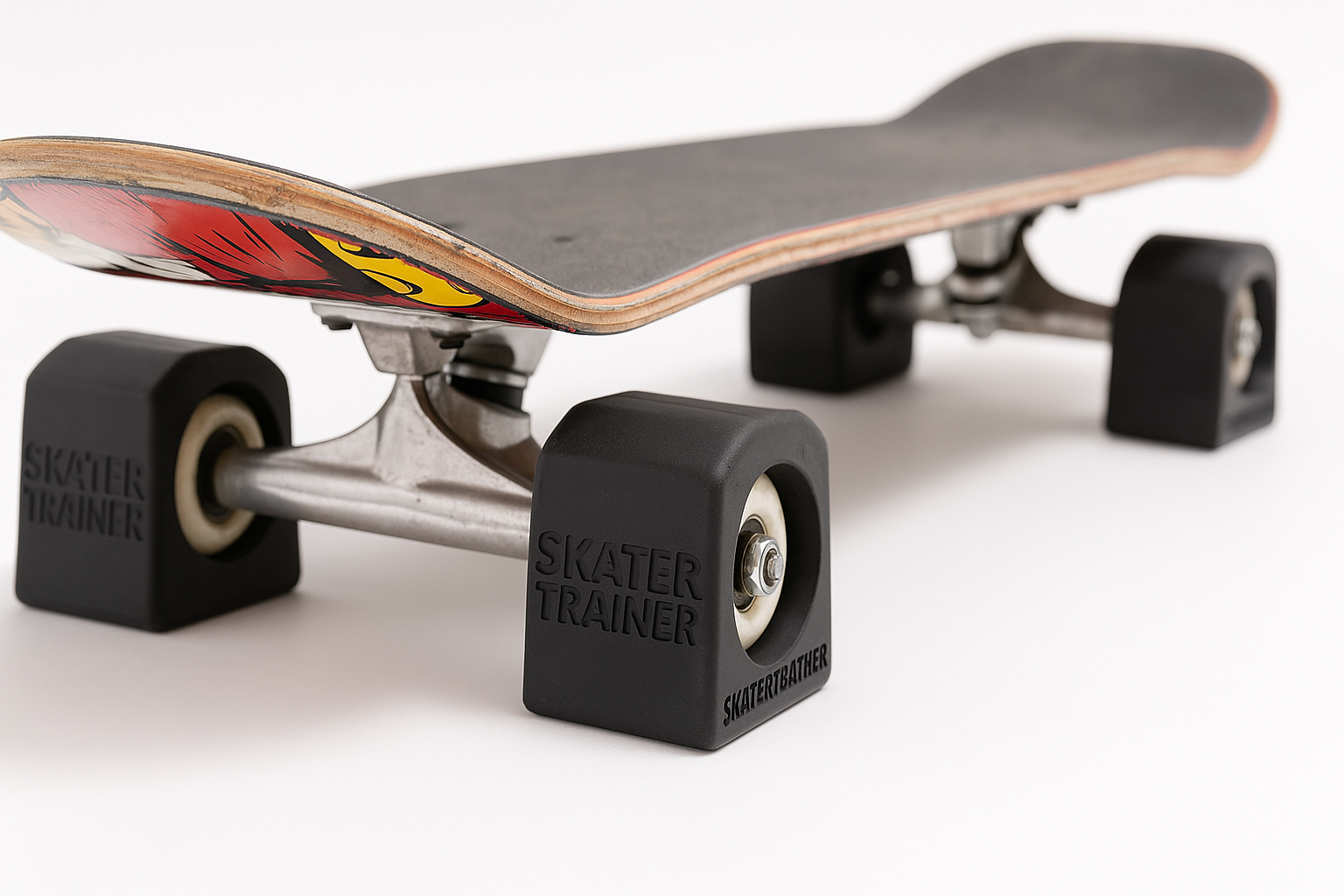
Out of the box, SkaterTrainers are four identical pieces of thick, flexible material—one for each wheel. They feel more like a heavy-duty rubber band than a plastic “training wheel,” which is good news for durability and grip. Each piece forms a loop that stretches over the skateboard wheel, creating a stable footprint on the ground when installed.
The material is slightly elastic but dense enough that, once mounted, the wheel can’t roll. Instead, the board rests on the outer surfaces of the SkaterTrainers, effectively turning your skateboard into a stationary platform that still has full pop and responsiveness.
Installation and Fit
Installing SkaterTrainers is straightforward:
- Place your board on its side so the wheels are exposed.
- Hook one edge of the SkaterTrainer over the wheel.
- Stretch it around until it fully wraps the wheel.
- Repeat for all four wheels.
There are no tools and no hardware to adjust, which is ideal if you’re setting these up for kids or for a quick practice session in the driveway. Removal is just the reverse: pull and peel them off the wheels.
The product is designed to fit most standard skateboard wheels used on street and park decks. In practice, they work well on the typical popsicle-shaped boards with wheels in the 50–60 mm range. They can also stretch onto slightly larger or smaller wheels, including many cruiser or old-school setups, but extremely oversized longboard wheels or very narrow specialty wheels may not be an ideal match.
Learning Tricks Stationary
Where SkaterTrainers really stand out is in early trick progression. With the board locked in place, you can break each trick into parts without worrying about balance or speed:
- Ollies: You can repeatedly practice the pop and slide motion while standing comfortably, paying attention to how your back foot snaps the tail and how your front foot drags up the grip tape.
- Shove-its and pop shove-its: Because the board won’t shoot out, you can experiment with how hard to scoop and where to land without chasing the board.
- Kickflips and heelflips: These tricks demand precise foot flick and commitment. Stationary practice helps you get used to watching the board flip under you and landing with both feet over the bolts.
This kind of focused repetition is especially useful for beginners who are still developing basic coordination and muscle memory. It’s also appealing for skaters returning from a long break who want to re-learn foundational tricks without risking a heavy slam on day one.
Confidence and Safety
Perhaps the biggest benefit isn’t purely mechanical but psychological. A lot of new skaters bail on tricks early because they’re afraid of the board slipping out. By removing that fear, SkaterTrainers make it easier to commit to each attempt, stay over the board, and learn what a proper landing actually feels like.
This can be particularly important for:
- Younger kids who aren’t yet comfortable with speed or falling.
- Parents who want to give their kids a safer way to practice without hovering over them every second.
- Anyone recovering from a big fall who needs to rebuild trust in the board.
SkaterTrainers don’t eliminate the need for helmets, pads, and good judgment, but they can reduce the frequency of classic “board shoots out, skater lands hard” scenarios during the early stages of learning.
Where They Work Best
Because they don’t require a smooth skatepark surface, you can use SkaterTrainers almost anywhere:
- A driveway or sidewalk
- A garage or basement
- Indoor spaces with enough ceiling height for ollies
Unlike practicing in grass or on carpet, you still get full pop from the board because you’re on a hard surface. That means the timing and feel of the trick translate better when you eventually remove the trainers.
Transitioning to Rolling Tricks
The most important thing to understand is that SkaterTrainers are a training aid, not a full replacement for traditional practice. Once you can consistently land a trick without the board rolling, you’ll need to remove the trainers and start working on the same trick at low speed.
This transition usually goes more smoothly because:
- You’ve already figured out the basic movement.
- You know what a proper landing feels like.
- You’re less likely to panic mid-trick.
However, you still have to learn how to manage balance, approach, and landing while rolling. Some skaters may feel a short adjustment period where tricks that felt easy stationary become harder when the board moves. That’s expected—SkaterTrainers shorten the learning curve, but they don’t erase it.
Pros
- Genuinely helps beginners learn fundamentals: Great for ollies, shove-its, and flip tricks where timing and foot position matter.
- Reduces fear of falls: Preventing the board from shooting out encourages full commitment, which is essential to landing tricks.
- Easy for kids and adults to use: No tools, no hardware, and quick installation.
- Versatile practice locations: Works on driveways, garages, and other everyday surfaces—no skatepark required.
- Compact and portable: Small enough to throw in a bag or pocket and use whenever you find a good spot.
- Makes a strong gift add-on: Pairs well with a first skateboard for birthdays, holidays, and stocking stuffers.
- Durable construction: Thick, flexible material designed to withstand repeated use and impacts.
Cons
- Not a substitute for real rolling practice: You still need to learn tricks at speed, which involves its own set of skills and fears.
- Limited use once you’re advanced: Intermediate or advanced skaters may only use them occasionally for new or switch tricks.
- Wheel-size constraints: While they fit most standard skateboard wheels, very unusual wheel shapes or large longboard wheels may not be ideal.
- Technique dependency: If you practice with poor form, SkaterTrainers won’t automatically fix that; you still need good instruction or tutorials.
Verdict
SkaterTrainers deliver on their core promise: they make it noticeably easier—and less intimidating—to learn and refine basic skateboard tricks. By stabilizing your board, they give you the freedom to focus on the details that actually matter: foot placement, timing, posture, and commitment.
For beginners, young skaters, and parents buying for their kids, SkaterTrainers are a simple, relatively low-cost upgrade at around $28.99 that can mean the difference between a skateboard collecting dust in the garage and a new skater sticking with it long enough to land their first real tricks. They won’t replace the need for rolling practice, and seasoned skaters may only use them occasionally, but as a learning tool they’re thoughtfully designed and genuinely useful.
If your goal is to learn ollies, kickflips, and other foundational tricks faster and with fewer painful bails, SkaterTrainers are an easy recommendation—and a smart addition to a beginner’s setup.