
SUNLU 1.75mm PLA Filament (Black, 1kg Spool) Review: Neatly Wound Everyday 3D Printing Workhorse
What This Product Is
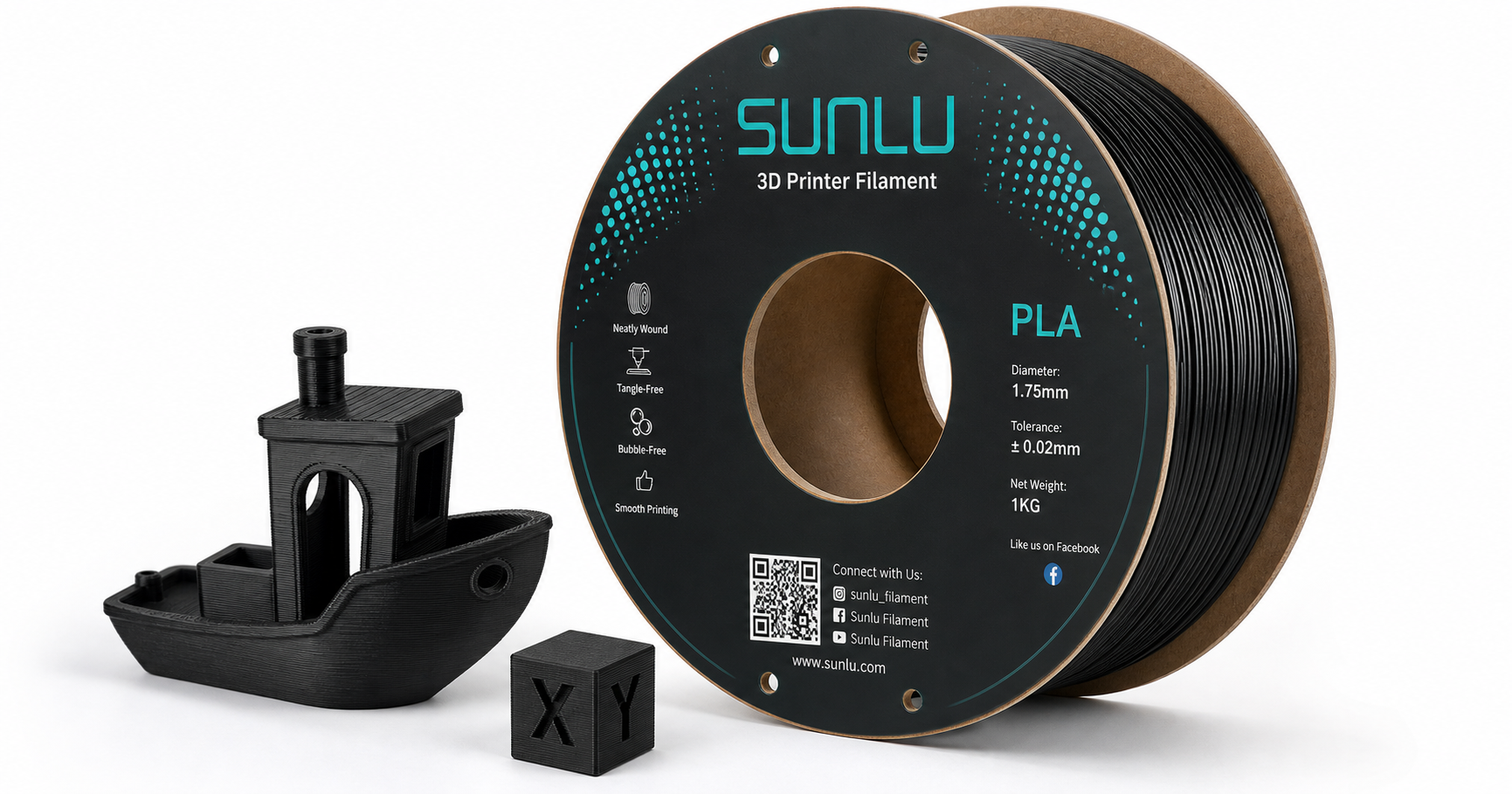
The SUNLU PLA 3D Printer Filament is a 1.75mm, black, 1kg (2.2 lb) spool designed for most FDM/FFF desktop 3D printers. It is a standard PLA formulation with a stated dimensional accuracy of ±0.02mm and is marketed as a neatly wound filament to reduce tangles and improve feeding consistency. The filament targets everyday general-purpose printing: prototypes, functional-but-light-duty parts, decorative models, and hobby projects.
On its product page at the manufacturer’s main retailer listing, this filament is typically positioned as an affordable, go-to option for users who want predictable PLA performance without premium pricing, often found around $12.59 for a 1kg spool.
Why It Matters
For most home and office 3D printer owners, PLA is the default material. The specific brand and quality of PLA you choose will have a direct impact on:
- How reliably your printer runs over long jobs
- The surface finish and accuracy of your parts
- The amount of tuning time you spend versus just loading and printing
SUNLU’s PLA line is widely used because it aims to strike a balance between cost, consistent manufacturing, and ease of printing. A filament like this matters if you:
- Print frequently and need bulk spools you can trust
- Use popular 1.75mm FDM printers (Creality, Anycubic, Prusa, Bambu, etc.)
- Prefer a plug‑and‑play experience rather than heavy material experimentation
If you’re building a stock of reliable, general-purpose PLA, this particular SUNLU 1.75mm black spool is a common candidate.
Key Advantages
1. Neatly Wound Spool Reduces Tangles
SUNLU emphasizes a neatly wound process on this series, and it’s one of its most noticeable benefits. A well-wound spool helps prevent hidden crossovers that can cause mid-print snags or sudden under‑extrusion.
In practical terms, this means:
- Less chance of the filament locking up halfway through tall, multi-hour prints
- Smoother feeding through Bowden and direct-drive extruders
- Easier visual inspection of how much filament remains on the spool
For users who leave printers running unattended for long jobs, this can significantly reduce print failures caused by filament path issues rather than printer settings.
2. Solid Dimensional Accuracy (±0.02mm)
The filament’s advertised diameter tolerance of ±0.02mm is competitive with many midrange brands. Lower variation in diameter leads to more stable extrusion flow, which helps with:
- Consistent wall thickness and infill density
- Reduced banding caused by intermittent over/under‑extrusion
- More predictable results across multiple spools
While real-world tolerances always vary slightly between batches, SUNLU’s PLA line is generally regarded as adequately consistent for hobby and light professional work when stored and handled correctly.
3. Wide Compatibility With 1.75mm FDM Printers
Because this is a standard 1.75mm PLA with typical printing temps, it is compatible with the vast majority of consumer FDM printers. Typical characteristics include:
- Nozzle temperature around 190–210°C as a starting range
- Optional heated bed around 50–60°C, or unheated with good adhesion aids (tape, glue stick, or textured bed)
- Suitable for common printers such as Ender, Neptune, Anycubic, Prusa, Bambu, and many others
If you often switch between brands or share profiles across multiple machines, this SUNLU spool slots in easily with minimal profile tweaks.
4. Easy to Print and Beginner-Friendly
As a standard PLA, this filament is tuned for ease of printing rather than extreme strength or heat resistance. Benefits for newcomers include:
- Lower warping tendency compared with ABS or PETG
- Good bed adhesion on typical build surfaces when temperatures and leveling are dialed in
- Less smell and fewer fumes compared with more demanding engineering filaments
If you’re just getting started, this material makes it easier to learn bed leveling, support settings, and slicer parameters without fighting constant warping or delamination.
5. Cost-Effective Everyday Choice
While prices fluctuate, SUNLU PLA is generally positioned as a budget- to mid-range filament line. The 1kg black spool at $12.59 tends to undercut some well-known premium brands while remaining more consistent than ultra-cheap, no-name alternatives.
For volume printing or stocking multiple colors, the ability to buy several spools at a relatively modest cost is appealing to:
- Etsy or small-shop makers running continuous jobs
- Schools, makerspaces, and labs that burn through PLA quickly
- Hobbyists batch-printing terrain, miniatures, or cosplay components
Key Limitations
1. Batch Variability Compared With Premium Brands
Compared with higher-end filaments, SUNLU PLA can show more batch-to-batch variability in:
- Ideal print temperature (some spools like slightly hotter or cooler settings)
- Surface finish and gloss level
- Occasional reports of brittle or moisture-affected spools if stored poorly or shipped in humid conditions
This doesn’t make the filament unusable, but you may need to run a quick temperature tower or re-tune slightly when you open a new spool.
2. Standard PLA Mechanical Properties
This spool is a classic PLA, not PLA+, PETG, ABS, or nylon. That means:
- Parts can be brittle under impact or repeated bending
- Heat resistance is limited; items can soften or deform in hot cars or near heat sources
- Functional components under mechanical stress may fail faster than with tougher materials
For purely decorative items or light-duty functional prints, this is fine. For long-term structural parts or outdoor use, it’s less ideal.
3. Sensitive to Moisture if Not Stored Properly
Like most PLAs, SUNLU’s filament will absorb moisture from the air over time. Wet PLA can cause:
- Popping or hissing sounds during extrusion
- Rough, bubbly surface finish
- Weakened layer adhesion
To get the best experience, you’ll want to store the spool in a dry box or sealed bag with desiccant, and occasionally dry it in a filament dryer or low-temperature oven if print quality declines.
4. Limited Specialty Features
This specific black PLA spool is geared toward general-purpose printing, not specialized use cases. It does not provide:
- Flexible or rubber-like behavior
- Extreme temperature resistance
- Specialty finishes (silk, matte, glow, carbon fiber, etc.)
If you need a very specific aesthetic or engineering property, you may want to look at SUNLU’s own extended lineup or other brands’ specialized filaments.
Who It’s For
You’ll get the most value from this SUNLU 1.75mm PLA black 1kg spool if you are:
- A beginner who wants a forgiving, widely supported filament to learn 3D printing basics
- A hobbyist running popular FDM printers and looking for a balance of cost, reliability, and acceptable dimensional accuracy
- A small maker or shop that needs a stock black PLA for prototypes, jigs, fixtures, and general-purpose prints without overpaying for premium branding
- An educator or makerspace manager equipping multiple machines with a uniform, easy-to-print material
If most of your workload is regular PLA jobs—figurines, holders, organizers, brackets with modest loads—this spool should cover a wide majority of your needs.
Who Should Skip It
You may want to look elsewhere if you:
- Need higher mechanical performance – For parts that experience repeated flexing, high impact, or elevated temperatures, consider PETG, ABS, ASA, or high-performance nylons instead.
- Require ultra-consistent pro-grade results – If you’re running a print farm with tight tolerances for commercial products or engineering applications, a more tightly controlled, professional filament line might yield fewer profile adjustments between spools.
- Want special visual effects – For metallic, silk, matte, wood-fill, or color-changing prints, this standard black PLA will not deliver those aesthetics.
- Have extremely moisture-prone environments and no drying solution – While all PLA needs some storage care, if you can’t control humidity at all, you may get better resilience with different materials or sealed, low‑moisture packaging.
Final Recommendation
The SUNLU PLA 3D Printer Filament (1.75mm, black, 1kg spool) is a strong candidate for an everyday, general-purpose PLA, especially if you value neatly wound spools, reasonable dimensional accuracy, and broad printer compatibility at a budget-friendly price point around $12.59.
It isn’t the toughest filament nor the most tightly controlled on the market, but for hobbyists, learners, and light professional use, it delivers a solid balance of reliability and cost. If your workload is dominated by standard PLA projects and you’re willing to do basic storage and occasional temperature tuning, this SUNLU spool is a practical workhorse to keep on your filament shelf.