
The Jesus Discoveries Review: Archaeology, History, and the Question of Jesus
Introduction
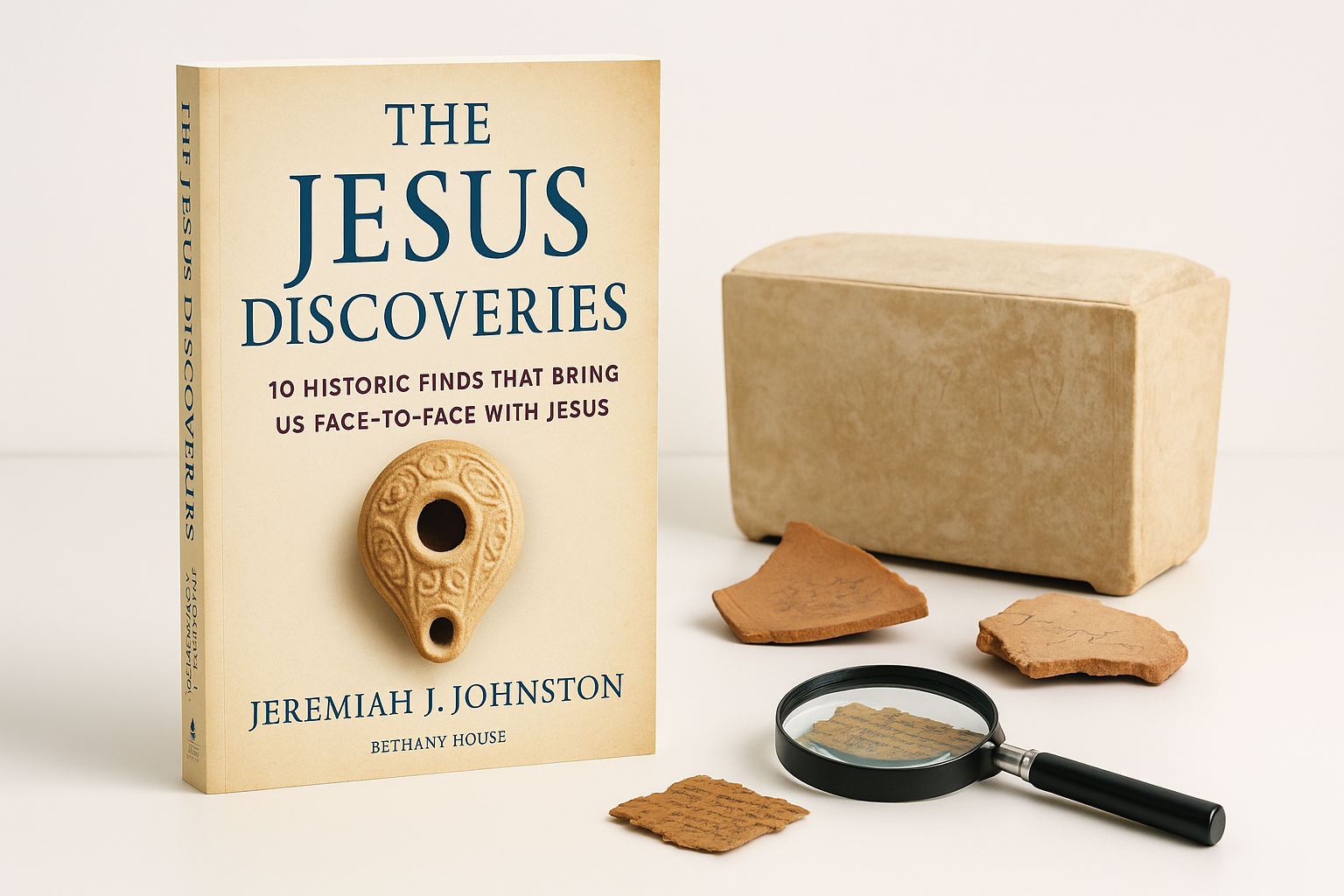
“The Jesus Discoveries: 10 Historic Finds That Bring Us Face-to-Face with Jesus” is a 176‑page paperback by New Testament scholar and minister Jeremiah J. Johnston, published by Bethany House. Positioned at the intersection of Christian apologetics and popular history, it addresses a common contemporary demand: “artifacts or it didn’t happen.” Instead of offering abstract philosophical arguments, the book walks readers through ten specific archaeological and historical discoveries that intersect with the New Testament accounts of Jesus.
Across the chapters, Johnston highlights items such as the Shroud of Turin, the Magdalen Papyrus, various early New Testament fragments, the Dead Sea Scrolls, the James ossuary, inscriptions mentioning Pontius Pilate, and early non‑Christian references to Jesus. Each example is used to illustrate how historical data can be brought into a conversation about Jesus’s life, death, and the emergence of early Christian faith.
Given its focus and scope, this book is designed more as an accessible introduction than as a technical monograph. It targets readers who are curious about whether archaeology and history support the plausibility of the New Testament narrative, including lay Christians, spiritually curious readers, and skeptics willing to consider the evidence.
In most bookstores and online retailers, the paperback is typically listed around $13.06, placing it in line with other new trade paperbacks in religious studies and apologetics.
Typical Use Cases
1. Christians Seeking Faith-Strengthening Resources
Many readers will approach this book from within the Christian faith, looking for material that consolidates or clarifies historical support for what they already believe. For this audience, the book serves as:
- A faith‑affirming overview of key archaeological and textual discoveries related to Jesus and early Christianity.
- A resource for small groups, Sunday school classes, or church discussion nights focused on apologetics.
- A starting point for readers who want to move beyond slogans (“there’s no evidence for Jesus”) into actual data and case studies.
2. Skeptically Minded or Curious Readers
A second likely audience is those who are skeptical or at least undecided about Christian claims, but are open to historically oriented investigation. For this group, the book:
- Provides a guided tour of ten prominent discoveries often cited in Christian apologetics.
- Explains how historians and archaeologists work with fragmentary evidence and why certain finds are considered significant.
- Offers a clear articulation of how these discoveries are interpreted in favor of the reliability or plausibility of New Testament accounts.
3. Students and Educators in Church or Homeschool Contexts
Because the book is written at a broadly accessible level, it has potential utility in educational settings, such as:
- High school or college‑age church groups being introduced to historical Jesus studies and archaeological evidence.
- Homeschool curricula that incorporate Christian worldview and apologetics.
- Supplementary reading for introductory courses on the New Testament, Christian history, or apologetics in Christian schools.
4. Readers Interested in Archaeology and Biblical History
Finally, the book functions as an approachable survey for readers who are drawn to the drama of archaeological discovery itself—how artifacts are unearthed, dated, debated, and then integrated (or not) into historical reconstructions of the past.
Performance in Each Scenario
For Christians Seeking Faith-Strengthening Resources
Accessibility: The writing style is deliberately non‑technical. Terminology around manuscripts, inscriptions, and dating is generally explained in plain language, making the chapters approachable even for readers with no prior background in biblical studies or archaeology.
Narrative Flow: Each chapter centers on a single discovery, explaining its backstory, what it appears to show, and how it is connected to a specific aspect of Jesus’s life or the early church. This chapter‑by‑chapter structure makes the book easy to read in segments, or to pick specific discoveries of interest.
Faith Integration: Johnston’s aim is explicitly faith‑fortifying. He does not hide his Christian commitments; instead, he argues that the historical data sits comfortably within a Christian understanding of the world. Many readers in church contexts will appreciate this straightforward integration of scholarship and belief.
Depth vs. Devotional Tone: Although devotional reflections are not the primary aim, the book frequently transitions from historical material to spiritual application—showing how the discussed discovery connects to the reader’s contemporary faith and life. For Christians, this can make the material feel more immediately relevant than a purely academic treatment.
For Skeptically Minded or Curious Readers
Openness About Perspective: The author writes as a committed Christian scholar advocating the reasonableness of Christian claims. Skeptics will likely recognize this as an apologetic stance, which is helpful insofar as it is transparent rather than hidden.
Engagement with Scholarly Debate: Johnston does introduce readers to some of the controversies around artifacts like the Shroud of Turin or the James ossuary, and he acknowledges that not all scholars agree on every point. However, the book usually summarizes debates rather than dwelling in technical detail or presenting a full spectrum of scholarly disagreement.
For skeptically minded readers, this means the book functions as a tour of one side of the conversation—thoughtful and informed, but clearly oriented toward a pro‑Christian conclusion.
Evidence Presentation: The ten discoveries are, in many cases, rightly regarded as historically significant: early New Testament papyri, Roman inscriptions referencing figures in the Gospels, and non‑Christian references to Jesus and early Christians are all mainstream subjects of academic study. The book helps skeptical or curious readers see that discussions about Jesus’s existence and the early church are grounded in real artifacts and texts, not just abstract debate.
For Students and Educators
Structure for Teaching: Because each chapter focuses on one discovery, educators can assign individual chapters to students as stand‑alone readings. Each chapter naturally suggests questions such as:
- What does this artifact tell us?
- How certain are scholars about its interpretation or authenticity?
- How—and to what extent—does it connect to the New Testament?
Supplement to More Technical Works: For high school and early college readers, the book can act as an entry point before they tackle more challenging primary literature or scholarly monographs. It gives names, dates, and core concepts that can be followed up in depth later.
Visual Potential: Although presentation can vary by edition, many discussions (e.g., inscriptions, ossuaries, manuscript fragments) lend themselves to visual aids. Educators might pair the book with images or museum resources to provide context and help students visualize what is being discussed.
For Readers Interested in Archaeology and Biblical History
Storytelling Around Discoveries: The book often leans into the narrative of discovery—where an item was found, how it came to scholarly attention, and why it caused debate. This can be especially engaging for readers who like the “detective story” aspect of historical work.
Scope and Selection: By limiting itself to ten discoveries, the book can treat each item with more detail than would be possible in a quick, encyclopedic survey, yet still remain brisk. The chosen examples collectively cover:
- Material culture directly or indirectly connected to Jesus (e.g., items related to crucifixion or named individuals like Pontius Pilate).
- Early Christian and non‑Christian texts referencing Jesus or his followers.
- Broader contextual discoveries (such as the Dead Sea Scrolls) that illuminate Second Temple Judaism and the environment in which Christianity emerged.
Strengths Across Scenarios
1. Clear, Accessible Explanations
The primary strength of “The Jesus Discoveries” is its clarity. Johnston consistently aims to explain complex issues—such as manuscript dating, artifact authentication, or the significance of an inscription—in language understandable to non‑specialists. This makes the book suitable for a wide range of readers.
2. Concrete Focus on Specific Evidence
Rather than remaining at the level of general statements about “lots of evidence,” the book anchors its argument in ten particular cases. This concreteness helps readers grasp what the evidence looks like—pieces of pottery, ossuaries, fragments of papyrus, inscriptions in stone—rather than imagining an abstract category of “proof.”
3. Integration of History, Text, and Theology
Each chapter connects three layers:
- The raw historical/archaeological data (what was found, where, and how it has been evaluated).
- The textual or contextual significance (how it relates to known historical figures, New Testament passages, or early Christian communities).
- The theological or existential implications (what it suggests about Jesus’s identity, the reliability of the biblical narrative, or the plausibility of Christian claims).
This integration enables readers to see how an item moves from being a mere artifact to having religious and philosophical significance.
4. Suitable Length and Readability
At under 200 pages, the book is short enough to be read in a few sittings. Chapters can stand alone or be read in sequence. The tone is conversational without being casual, striking a balance between seriousness and accessibility.
5. Usefulness as a Gateway Resource
For those just beginning to explore the historical side of Christianity, “The Jesus Discoveries” offers an inviting starting point. It names key artifacts, texts, and debates that readers can later investigate through more specialized books, articles, or lectures.
Limitations Across Scenarios
1. Introductory Rather Than Exhaustive
Readers looking for deep engagement with academic debates will find the treatment introductory. Technical questions—for example, fine‑grained arguments about manuscript dating, detailed chemical analysis of artifacts, or comprehensive presentation of opposing scholarly positions—are largely summarized or only briefly noted.
2. Confessional and Apologetic Orientation
The book is written from a committed Christian standpoint, with the explicit goal of supporting the “truth of Christianity.” For some readers, this confessional and apologetic orientation will be a feature; for others, it will raise questions about selection bias or interpretive framing. Skeptical readers may wish to supplement it with works from a broader range of perspectives.
3. Limited Space for Nuance on Contested Artifacts
Some of the highlighted discoveries—such as the Shroud of Turin or the James ossuary—are highly contested in terms of authenticity and evidential weight. Given the book’s length and audience, it cannot fully unpack the complexity of these debates. Readers who want a detailed sense of why reputable scholars disagree will need to pursue additional resources.
4. Possible Expectation Gap for Academic Readers
Because Johnston is a recognized scholar, some academic or semi‑academic readers may expect a more technical work. Those seeking footnotes, extensive bibliographies, or rigorous engagement with secondary literature may find the style closer to a popular apologetics overview than to a research monograph.
Verdict
“The Jesus Discoveries: 10 Historic Finds That Bring Us Face-to-Face with Jesus” is best understood as an accessible, faith‑oriented introduction to some of the most discussed archaeological and historical data points related to Jesus and early Christianity. Its core contribution is to bring concrete artifacts and texts into view for readers who have heard claims—either that there is “no evidence” for Jesus or that there is “overwhelming proof”—but have never had those assertions grounded in specific, examinable cases.
For Christians seeking to better understand how archaeology and historical research intersect with the New Testament, the book offers a clear and engaging overview that can strengthen confidence and prompt deeper study. For curious or skeptical readers, it provides a structured tour of evidence as interpreted by a Christian scholar, which can serve as a starting point for broader investigation and dialogue.
It does not aim to—and does not—settle every scholarly debate or present a comprehensive, critical survey of all positions. Instead, it functions as a well‑written, confessional gateway resource. Readers who approach it with that expectation, and who are willing to supplement it with additional perspectives where necessary, will likely find it a valuable and thought‑provoking introduction to the historical and archaeological questions surrounding Jesus.
For those comfortable with this balance of accessibility and apologetic intent, the book’s content and typical retail pricing around $13.06 make it a reasonable entry‑level purchase for personal reading, group study, or church libraries.